
I think that understanding the context in which Malcolm originated the Non-Naive Trust Dance helps to understand it more accurately and deeply. Accordingly, I will name and describe a few of the major, direct influences on NNTD here. I’ll also include some other ideas, which may not have been direct causal influences, but are adjacent and resonant.
The intention is less to serve as a historical or causal account for the sake of accuracy, and more to surface relevant ideas for those seeking to understand NNTD.
General Background
There’s a long history of exploration into the nature of trust. My friend Riccardo points out that a lot of these efforts and lines of thinking “reached Malcolm both directly and indirectly.” He gives a few pointers to some places where we might learn about the broader context of thinking about trust:
- The Ethics and Epistemology of Trust | Internet Encyclopedia of Philosophy
- Trust (social science) – Wikipedia
- Trust (Stanford Encyclopedia of Philosophy)
Upstart Collaboratory & Jean Robertson
Malcolm lived for many years at Upstart Collaboratory (aka the Liminal Space Agency), a community and “culture incubation project” based in Waterloo, Canada:
In mid-2012, I met some people who were on a mission to create a new kind of culture they described as “collaborative”, a word which also means “working together”. I was immediately very into it, and joined the weekly meetings of 8-15 people. The meetings would often get off to a slow start, but then most of the time by about 90 minutes into the 2h meeting, we had cultivated a collective space [that might be called “the synergic mode“]. We’d often connect in smaller groups for an hour or two after the meetings, still feeling that glow and openness.
The group had observed that it was fairly straightforward to get people into this new mode in the context of a weekend event, so the deeper question was “how do we get people embodying this other mode ongoingly, as a self-aware collaborative culture?”
In mid-2013, I moved into the house where people were aiming to embody this new kind of culture 24/7, where I lived until I moved out in 2020.
This community is centered around Jean Robertson.
Jean was my mentor and close friend and main-sensemaking-person for many years.
She’d spent 50 years developing some powerful ideas & practices for how human interaction could be way more workable than it usually is. I spent 8 years learning closely from her, before I had something like a Kuhnian paradigm shift that incorporated anomalies, at which point I started working more autonomously with my new paradigm.
[I]… learned a lot from her, both from what she taught me and from watching where she gets stuck.”
In many ways, the Non-Naive Trust Dance is a response to, extension of, and constructive criticism of Jean and Upstart’s ideas and philosophy1Malcolm: “Jean and I, and others in the scene, have sometimes framed the NNTD paradigm as a fork off of Jean’s paradigm. It seems to me that this is apt as long as we get a bit more precise here: I couldn’t possibly have forked Jean’s paradigm—I could only fork my understanding of her paradigm.”.
There are two core documents that articulate Jean and Upstart’s philosophy:
- Our Commitments & Assumptions: a document about living and collaborating from a shared foundation of self-acceptance, curiosity, learning, and growth.
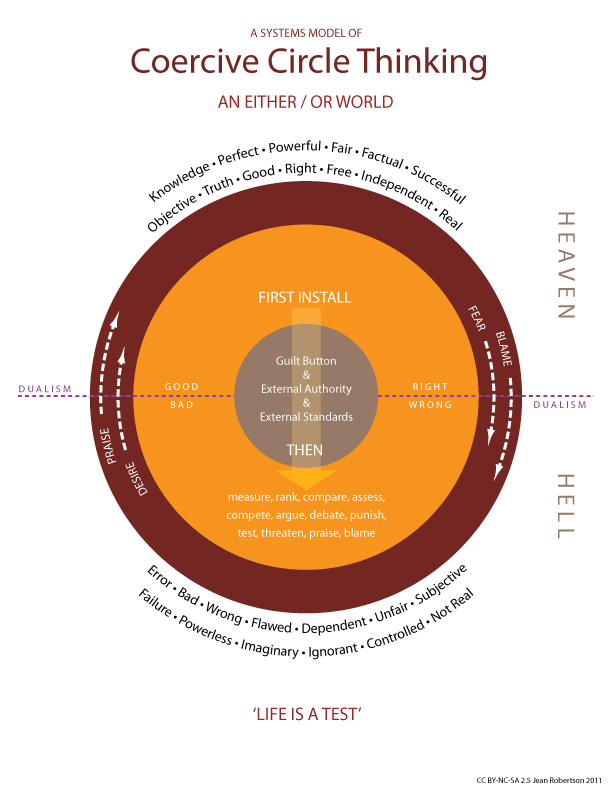
- Circles Maps: explores two distinct ways of experiencing the world “from a systems or ecological point of view”, based on “our deepest assumptions as individuals and as a culture about how the world works”—the coercive and collaborative circles
 |
 |
|---|
The Circles Maps, CC BY-NC-SA 2.5 Jean Robertson
Both of these documents point towards what the Upstart folks call “the collaborative mindset.”
Here is a copy of these documents, should they become unavailable. I recommend reading them, both of their own merit and as important context for understanding the Non-Naive Trust Dance!
U can watch a video of Jean talking about her ideas on The Stoa here.
Coherence Therapy
The book Unlocking the Emotional Brain, and the larger perspective of coherence therapy and memory reconsolidation that it presents, have been a major influence on Malcolm and NNTD. Coherence Therapy says that our emotional symptoms and behaviors are not random or pathological, but rather represent the person’s unconscious solution to an underlying issue or need.
Memory reconsolidation offers a non-coercive (counteractive) approach to genuine psychological healing: juxtaposing the felt truth of our ingrained beliefs and patterns (schemas) with lived experiences that contradict those schemas, so that we can update to new, more accurate, more useful beliefs.
Importantly, practicing Bio-Emotive gave Malcolm “the first-person lived experience that let [encountering] Coherence Therapy… hit me so vividly.”
Kaj Sotala has an introductory post to the book and its perspective on LessWrong; Cedric Reeves has another, shorter post here. There’s also a great thread from Benjamin Carr on applying principles from Coherence Therapy to everyday life.
Perceptual Control Theory
Perceptual Control Theory was created in the 1950’s by William T. Powers, modeling behavior from the lens of control theory, systems biology, biological cybernetics, and the concept of feedback loops.
Malcolm describes PCT as a “paradigm shift to psychology that’s still in the process of overturning linear/behaviorist models….[it] provides an emotional-coherence-compatible model of the nature of behavior and conflict…of how motivation works on all levels of abstraction down to muscle actuation.”
PCT “frames behavior as being in service of satisfying reference levels on various levels of abstraction,” like the setting of a thermostat—except there are many, many such reference levels, on many dimensions of our experience.
From the perspective of PCT, shows how inner conflict and “fighting yourself leads to gridlock or oscillation, without the need to anthropomorphize one’s interior.”
If U want to learn about PCT, read Making Sense of Behavior.
Divided Brain Theory
Iain McGilchrist’s version of the divided brain is a more nuanced version of the right/left hemisphere brain theory, that discusses how each hemisphere attends to the world. In his presentation, the left hemisphere focuses on small details, words, logic, and reasoning, while the right hemisphere has a more holistic perspective that can see the whole picture.
Malcolm:
Reading McGilchrist in 2019 was hugely clarifying for me, because I realized that I’d been trying to force my left hemisphere to become a right hemisphere, and so it was a relief to discover that instead I just needed the left hemisphere to learn how to relax. That wasn’t as easy as I thought it’d be, in part because the LH doesn’t like to relax when it’s holding onto some sort of distrust, and that’s part of where the NNTD comes in—welcoming and integrating that distrust into the larger whole.
Malcolm has a series of Twitter threads on McGilchrist’s work and the divided brain model here. If you want to learn from McGilchrist directly, you can read his book Ways of Attending: How our Divided Brain Constructs the World, which is a short and approachable introduction to his work; or his longer text, The Master and His Emissary. Malcolm also recommends this podcast on learning and this video that talks about global conflict, or his documentary, The Divided Brain. Some people also like this RSA animation.
Other Influences
Here are a number of other influences on the Non-Naive Trust Dance, as well as some adjacent ideas and theories worth mentioning in connection with it:
- Mark Lippman’s meditation protocol, and in particular the concept of Layering, the difference between adding and removing layers when doing self-transformation.
- Unflattening by Nick Sousanis: a philosophical graphic novel about perspectives and worldviews
- Game A & Game B
- Desiderata for any future mode of meaningness by David Chapman
- Trust as an Unquestioning Attitude by C. Thi Nguyen
- Bonnita Roy on Trust: A Source Code Analysis of Trust
- If by Rudyard Kipling: “If you can trust yourself when all men doubt you, / But make allowance for their doubting too;”2Malcolm notes that while he had heard of the quote before the NNTD insight, he discovered the connection after. In this way, the Kipling quote is less of an influence, strictly speaking, and more of a pithy, resonant articulation of the NNTD core insight.