
Malcolm frames his NNTD not merely as a theory or set of practices—which is largely how I’ve related to it myself—but as a law, protocol, and metaprotocol. I’ll discuss and differentiate those terms here.
A law is a necessary quality of reality, an inevitability. It is impossible to disprove a law because U cannot enter a reality that does not work according to this law. It often looks like a tautology.
Malcolm claims that NNTD is a law, concerning fundamental realities applying to any learning systems. NNTD is not exclusively about people or human relationships. It generalizes to learning systems more broadly. That includes humans, but also cells, animals, forests, groups, societies, AI’s, aliens, etc:
“as a system learns, it accumulates signals about what to trust and what to distrust, and healthy coordination comes from honoring those signals rather than overriding them.”
“Some parts [of NNTD] only show up once a system can reflect on itself…once a learning system has a sufficient amount of self-awareness / meta-cognition… so human examples dominate—
Because it applies to learning systems in general, Malcolm frames NNTD as a law, which is “at least as fundamental as entropy, possibly as evolution.”
A theory is an explanation of why things work the way they do, that has survived empirical testing. It is possible to imagine a coherent world in which a given theory is different, and therefore it is possible to design experiments that prove or disprove that theory empirically.
NNTD is also a theory or account about how the laws governing trust and distrust in learning systems apply to human social reality, trust, and distrust in particular.
NNTD is also an emergent set of associated practices, similar to Non-Violent Communication (NVC), Circling, Joe Hudson’s VIEW, or Dr. Hazel-Grace Yates’ Art of REPAIR. Malcolm describes these kinds of techniques or frameworks as protocols:
A protocol is a set of behaviors and expectations for interaction, whether explicit, such as NVC (“Non-Violent Communication”), or just the unspoken cultural norms of any social group. Shared protocols can dramatically increase people’s ability to collaborate and trust each other. But trying to get everyone to operate the same way is imperial, like trying to get everyone to speak the same language, and thus generates a ton of resistance if you try it.
Malcolm gives another good example of a protocol, the classic American opening conversational banter: “Hi, how are you?” “Oh, I’m fine, thank you. And you?” “I’m good, thanks.”
However, protocols like NVC or Circling, useful as they are, are insufficient. What do U do when someone is unfamiliar with them, or unwilling to use them? When they have objections to their assumptions or norms?
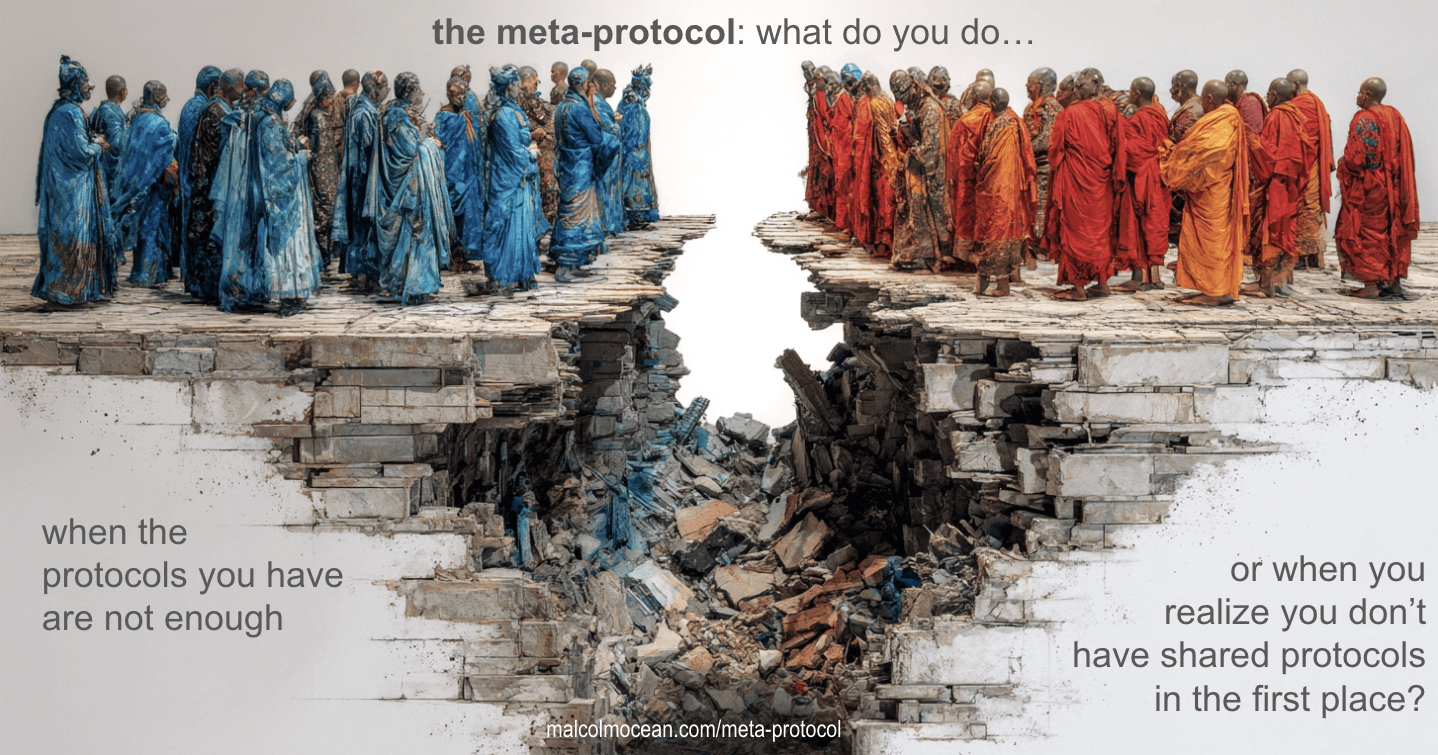
These quandaries give rise to what Malcolm and others call a “metaprotocol”—the process or activity of deciding which protocol to use for interacting: “Somehow… you need to deal with the fact that you don’t have a shared protocol, while not having a shared protocol.”
Malcolm describes the Non-Naive Trust Dance as a law, a theory, a set of practices—as a protocol, and also a meta-protocol.
For myself, at this time, I mostly see NNTD as a theory and a set of practices. I don’t see myself as being in a position to accurately evaluate whether NNTD is a law or not. I find the distinction between a protocol and meta-protocol an interesting thought experiment or conceptual frame, but perhaps less acutely salient in practice for me, personally.
To put it in NNTD terms: I don’t trust myself to be able to discern whether NNTD is a law or not! If that distinction matters to U, I trust U to make sense of these ideas in a way that is clear and useful to U!