
Sometimes U learn a word that changes your life. It describes something U didn’t know needed describing, fills a hole in your map U didn’t know was there.
This blog post is about a word that changed my life to learn: dyspraxia1this word-finding is the opposite of British philosopher Miranda Fricker’s hermeneutic injustice: “when someone’s experiences are not well understood — by themselves or by others — because these experiences do not fit concepts that can be found in popular language.” (Wikipedia)
a philosopher in Fricker’s world might call what I am referring to hermeneutic justice or hermeneutic repair. i would call it “the delightful satisfaction and particular-unexpected-relief of finding a word U didn’t know U needed—and the abundant freedom and relief and benefit that necessarily ensues.”For another example of hermeneutic justice, see my post about ACHOO..
I was reading an essay from my friend David MacIver—Words and Bodies—when he described the word.
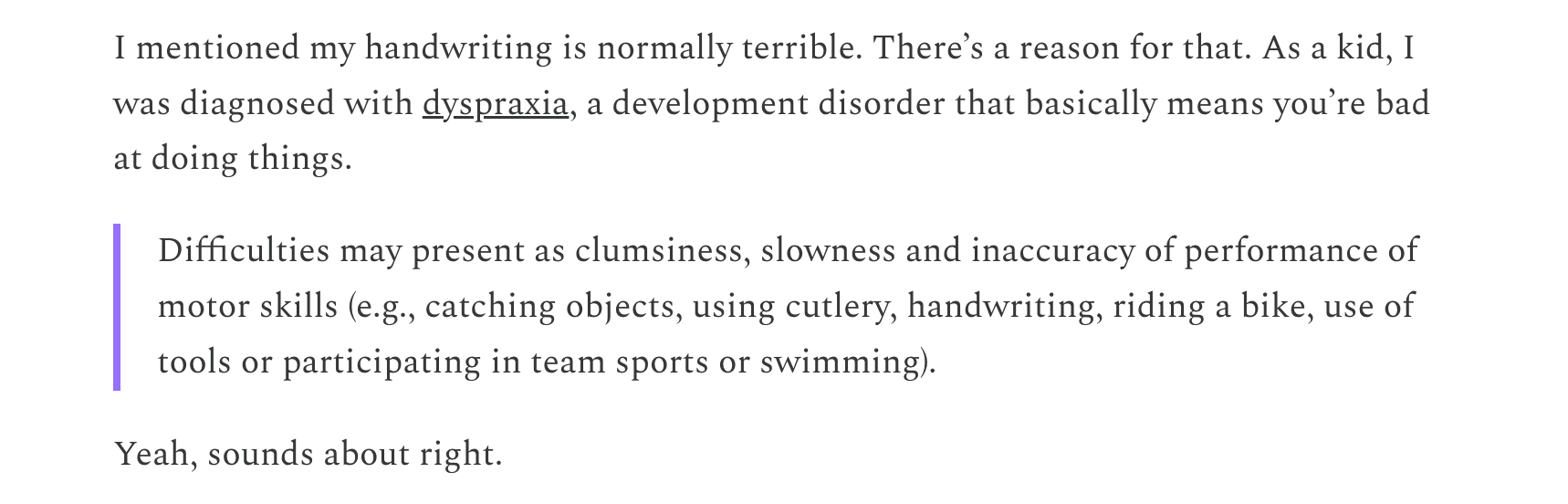
And I thought, “Aha! That’s what I have!”
U know dyslexia? It’s a condition involving difficulty reading, from the Greek roots dys (“bad, abnormal, difficult”) and lexis (“word”).
Dyspraxia is also a learning disability, but for someone who has difficulty navigating the world, with mechanical skills, and embodied proprioception.
I’ve historically had such a hard time manipulating physical objects, understanding how they work, using spatial intelligence, etc.
In school, I would pathologically avoid sports. I had weird resistance to things like routine cooking or learning new physical skills. And I was hilariously, comically bad with everyday objects like doors and locks2It sure seems like virtually every door is totally different! They really don’t work the same! It’s like learning a whole new language or grammar or vocabulary with every lock and key and door and latch!. Over the years this has caused me no end of frustration, embarrassment, and difficulty.
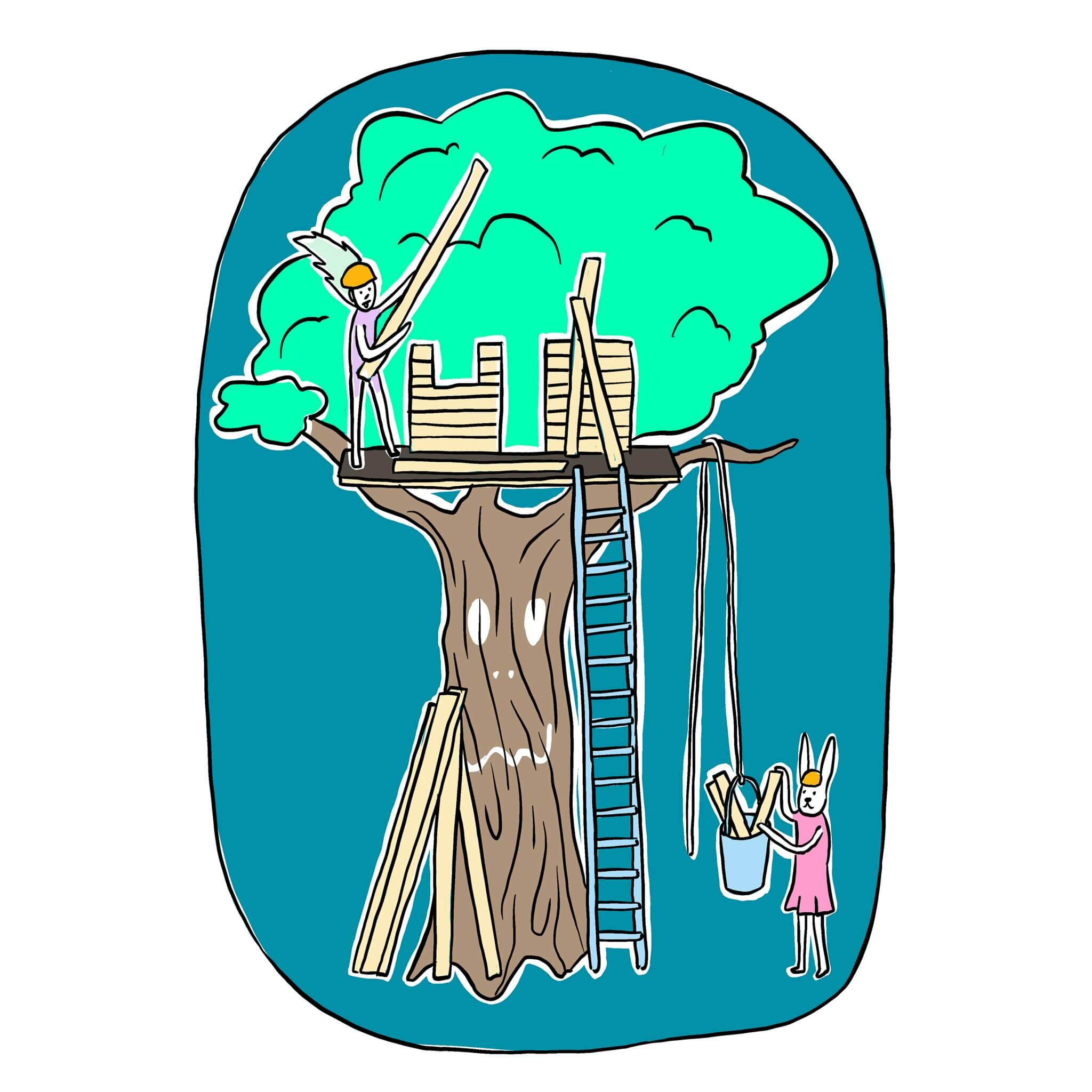
Learning about dyspraxia has been so helpful and explanatory for me. And since then, I’ve learned a number of strategies and tactics—not just for working around dyspraxia’s inconvenience, but for cultivating praxia. This post will share what I’ve learned!
The Challenge of Dyspraxia
There are two levels of difficulty with dyspraxia: the immediate practical difficulties of understanding physical objects and proprioception, and the emotional aspect of stored trauma associated with this confusion.
That trauma can cause us to disassociate from things that might require us to use skills we don’t have, or to subtly avoid situations that could bring up challenges.
For example, in fifth grade I was required to take a music class—band, orchestra, or chorus. I remember that I chose chorus, in part because it wouldn’t require me to learn an instrument. It felt simpler, less scary.
I’ve realized that, for me at least, a component of dyspraxia is the experience of words/labels being disconnected from sights/visual inputs of objects being disconnected from the physical tactile/kinesthetic experiences of touching those objects.
For example, I have heard the word hi-hats; I have definitely heard the sounds of hi-hats before; and I’m reasonably confident that I’ve even hit a hi-hat physically before on a drum. But I can’t for the life of me at this moment connect those three experiences. It’s like aphantasia, but for words and objects.
This can cause me to disassociate when people give me verbal/intellectual explanations of things, because I can’t keep up with the words they’re saying, especially when they’re disconnected from real present physical experiences.
I remember being amazed when I realized that other people actually understand verbal instructions. Someone can explain something to them, and then they get it! Crazy!
I don’t tend to understand verbal instructions unless they are delivered in a very specific way that works for my nervous system and learning type. Instead, I disassociate, glaze over, and feel hopeless that I’ll ever learn what’s being shared—which is unfortunately a self-fulfilling prophecy!
What Actually Helped
Reframing Dyspraxia: Probably the biggest change that helped me was reframing the story that I had in my mind about myself. At first, it was relieving to label myself as dyspraxic; finally, I had a name for everything that I had been going through. But eventually, that became a kind of prison where I identified with the label and the disability.
Eventually, I decided to reframe my experience: to see it as choosing to cultivate praxia.
Rather than avoiding situations that would bring up my dyspraxia, I leaned into the challenge and actively looked for opportunities to cultivate praxia. Rubik’s cubes, juggling, skateboarding, martial arts—all learning opportunities rather than threats.
Practicing Tai Chi, for example, helped me to become more graceful, smooth, and fluid in the way that I move through the world.
I am actively cultivating the ability to orient towards objects in a smooth, fluent way—the ability to navigate the world with confidence.
Finding Patient, Loving, Skilled Friends and Mentors: Finding people who understand dyspraxia and are able to meet me there has been so helpful in this journey. People who make me feel seen and understood. People who respond to my requests and needs. People who explain things conceptually in a way that I can understand them.
Two such people stand out as having been especially helpful mentors in this process.
Catherio
My friend Catherio was very helpful. I got a download just from being around her. She was very praxic, able to explain physical skills in a loving, calm, attuned way that made sense to me, and also able to listen to my experience and help debug anything that wasn’t working.
In one notable example, she taught me how to safely chop with knives, and assess their sharpness or dullness—an exercise that showed me much, much, more than the immediate skill at hand.
Loving Presence: Catherio suggested that I use my skill of mindfulness to be present with the external sensations, and my skill of lovingkindness to be loving towards myself—to cultivate loving presence when learning something new or facing a challenge in the physical world.
Shortly after I spent time with Catherio, I flew to Brooklyn. I arrived quite late at night. It was very, very cold out, and I was looking forward to falling into bed.
My host was gone, and there was a lockbox with the key for me to get inside. Unfortunately, the lockbox was stuck. I was frustrated because it was late at night, it was freezing, and above all, I doubted my ability. My hands were starting to freeze along with the metal. I started imagining having to find a hotel late at night.
I remembered Catherio’s advice about loving presence and decided to keep trying. I focused on being present and mindful with the external sensations of the lockbox while being internally loving with myself. It took a number of tries, but eventually I was able to open the lockbox and get inside. This was a really big win—in a moment that mattered!
Describing What I See: Catherio suggested that I describe what I see aloud. That can help me orient towards my senses and make sense of it. It also helps someone else who’s teaching me to understand my moment-by-moment experience and give tailored feedback.
Believing I Can: Catherio showed me that I had believed there were a whole swath of things that I cannot do, because I didn’t have various prerequisites. But that’s not true!
She gave me confidence that if I put the pre-requisites in place with the help of a teacher I trust, in a learning context I feel safe in, I can develop mastery in anything. In other words, she demonstrated and imparted the belief that I can do everything, in any domain.
Obviously, I may not do everything—I may never go parasailing or stunt diving—but mastery is possible in all domains. Catherio really believes that in her body, and spending time with her helped me to do so, too, on a deeper level.
Rich
My friend and mentor Rich has also been very helpful with cultivating praxia. When I was with him in person at Casa Tilo, he helped me go through various physical exercises in a way that made sense to me and worked for my learning style.
Touching Objects, Finding Referents for Words: Rich showed me several different kinds of wrenches. He let me hold them and touch them as he explained them. He suggested that when I listen to words, I should try to see if I can find referents for them in my own experience.
I found that touching them, listening to his words, and tracking my own experience gave me a real visceral understanding of how these tools worked, in a way that was distinct and meaningful beyond my normal experience of “learning” how tools or objects work.
Watching YouTube Videos: Rich gathered this thread of YouTube videos that share videos of people working on physical projects like plumbing or construction, and has encouraged me to watch these videos (and this kind of thing) as a way to cultivate praxia.
Learning is an End In Itself: He passed on a phrase and state of mind from his father, that learning how something works is valuable in and of itself. I would have agreed with that on paper previously, but him saying that made me realize that I was typically only willing to learn new physical skills if I could see it was necessary for a goal I wanted to achieve.
Other Strategies I’ve Discovered
Going Slowly: Proceeding slowly is helpful if something feels scary, overwhelming, or just very new.
Noticing Voice: The voice that someone says instructive words with seems to matter quite a bit for my ability to process and learn from their verbal instructions. Their volume and speed of speaking can massively affect my ability to download new information about the physical world through words and speech.
Fast or loud feels aversive, hard to focus on, easy to disassociate from.
Slow and quiet feels gentle, easier to work with, smoother to learn from—especially if they are attuned to me, and tracking whether I’m understanding or not. I can also pause them to ask questions if they go slowly.
Use My Body to Mirror What I’m Learning: Using my body to physically represent something someone is trying to show me helps me understand better, and also allows the other person to track my understanding and pace the learning accordingly.
Actually Do The Task: Above all, it’s important that a teacher or instructor actually let me do the task. They can explain it, they can show me how they do it, but I need to actually try to do it with my hands and body—to have them watch me, offer feedback, and let me ask clarifying questions. A verbal explanation alone is insufficient—and may even be unnecessary or unhelpful.
Conclusion
One of the best compliments I got recently was after spending time with a friend of mine in person. When I mentioned dyspraxia, they said that they didn’t believe that I have it, because I seemed perfectly fine with the world and physical objects. I was so flattered! I’ve come such a long way!
I hope that what I’ve shared in this post will be helpful to other folks who want to feel more confident and competent in the physical world. May all dyspraxic beings cultivate praxia ❤️
Thank U to David MacIver for introducing me to the word dyspraxia. Thank U to Catherio, Rich, and many others who’ve helped me to cultivate praxia.
The art in this post was created by Sílvia Bastos, and is licensed under a CC BY 2.0 license. You can support her work on Patreon.