phenomenological status: exploratory, tentative, intuitive; excitable, interesting, meaningful, signalling importance
It is possible to have a precious, but hard to describe experience of collective consciousness. We might also refer to this experience as a “we-space,” or entering the “synergic mode,” or simply as finding an “us.”
silent retreat, day four. in the kitchen. after lunch. twelve people in a small room. there is a rhythm, there is a knowing, there is a sense of what is to be done and how to do it. dishes to be cleaned, food to put away, fixed amount of time in which to finish.
everything flows. everything moves. it’s less that i am me and U are U, and more that we are we. we are an octopus, limbs sliding and flowing; we are a synchronous orchestra, and the task being done is our music.
the way we move our bodies is harmonious, elegant, spontaneous. we are aware of the whole room, of all that is to be done. inventive actions are taken. the mysterious, beautiful, and unexpected arises in the midst of the totally ordinary act of sponging a plate or drying a knife.
there is a satisfaction in this. in setting aside the noise of words, and finding vibrant silence. in setting aside the narrow box of Me, and instead finding Us, right here where we’ve been all along.
I want to learn how to enter this territory more easily, more often—and I want to help others learn about them, also, and to do the same.
This essay intends to explain some things about “we-ing” or “us’es,” to articulate them clearly, and thereby to facilitate our shared understanding of and access to these states.
There are many doors to this experience. Finding it is intrinsically precious and meaningful, but also circumstantially useful. It behooves us to familiarize ourselves with these states and experiences, to understand them more deeply and to gain skill in entering them.
circling. there are six or seven of us. we’ve been in it for two hours. i’ve been annoyed and confused and curious. i’m tired, but invested. i want to see what happens. i want to know what this person will do about what they’ve shared.
and gradually, a sense dawns on me, on us. i can’t say how i know, but i know that we know. there is a knowing that we share, an experience that is seen and felt and held in common. it is not just me seeing what i see—We are seeing it.
Normally, in English, I speak of myself or of someone else, of “I” and “you”, self and other. But it is also possible, in certain contexts, to speak accurately and usefully about “us,” to speak for a collective, from “we.”
Speaking in “we” creates or surfaces an “us.”
Giving a name to that “us” can help stabilize our access to, self-recognition of that “we.” Giving a dyad or triad or larger group a name helps it to form, become self-aware.
An “us” or “we” can include care for “me” and “U.”
Staying connected to our selves—our truths, our needs and preferences, our desires and boundaries—makes it possible to assent to, align with a collective in a healthy way.
To the extent that we have that self-knowledge and self-care, it is safe to do so. To the extent we do not, our experience will be dominated by fear, anxiety, shame, and distrust.
In particular, a healthy, sane understanding of boundaries and distrust (NNTD) is especially useful to have mastered by all individuals, well-distributed in the collective awareness. We might also find it useful to be aware of lists of cult-like behaviors—the collective, often gravitational tendency towards unhealthy group dynamics.
In the same way that we might do Parts Work (e.g. Internal Family Systems) within ourselves to find internal alignment and harmony (aka Self Energy), it is possible to find group flow, collective intelligence, we-spaces.
Moves that apply at one scale (e.g. within oneself) apply at others also (including in dyads and triads, quads and quints, and larger crews and congregations).
The same moves that help build internal understanding and harmony apply to external contexts and coordination, also.
Having a high degree of shared context helps create the conditions for a “we” or an “us” to arise. What was explicit, expensive, slow and bulky form of communication can increasingly become implicit, inexpensive, rapid and intuitive form of communication.
Verbal, word-based communication can be supplemented by nonverbal communication, embodied cognition. Modalities like contact improv, ecstatic dance, etc. connect us to a primal substrate of intuitive interpersonal connective tissue that is found and expressed through movement.
In the same way that one might individually find it useful to articulate one’s values, or to list one’s goals, we can articulate our shared values and goals as a “we,” an “us.”
It can be helpful to discuss which energies specifically are being exchanged in relationship, what U are each giving and receiving—how that feels, and what, if anything, wants to be shifted.
Similarly, it can be helpful to discuss with your friends in which respects U view each other as senior and junior in—senpai and kohai—and which of those dimensions U would mutually like to learn and grow and teach and play in.
Everyone is more or less skilled, in different respects or dimensions at different times. Admitting this honestly enables exchange and development, trade and commerce, individual growth and mutual flourishing.
Mutually practicing heartspace meditation and the ability to connect to morphic fields helps build intuition for accessing somatic and imaginal pathways between selves, towards “we’s” and “us’.”
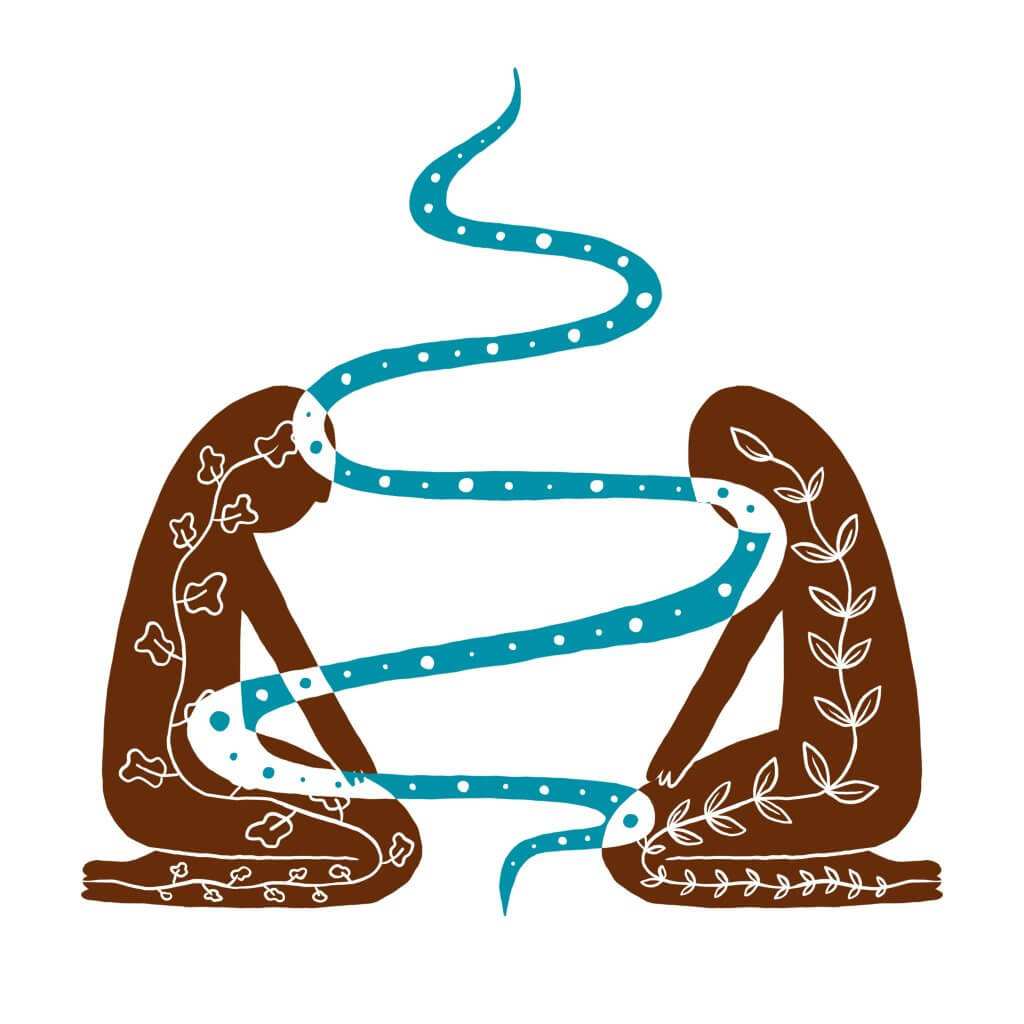
The art in this post was created by Sílvia Bastos, and is licensed under a CC BY 2.0 license. You can support her work on Patreon.