
I read Tyler Cowen and Daniel Gross’ book Talent (2022) a few years ago. At the time, I was starting my Empowerment work with my collaborator Mary and The Service Guild. I wrote most of this piece then, as a summary of some of their ideas, as well as of my fundamental disagreement with their perspective.
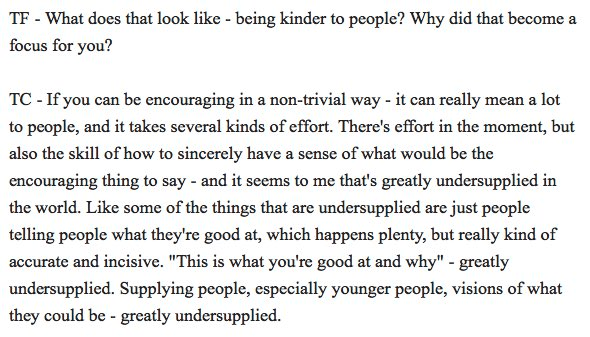
I’d known about Tyler Cowen for many years, but he began to truly inspire me when I read this quote from his podcast episode on the Tim Ferriss Show:
I was also inspired by Tyler’s work with Emergent Ventures—I admire the structures he has built to support projects he believes in.
For this reason, I was very excited to read Talent, and to understand his thoughts and approach to identifying and cultivating talent.
Tyler and Daniel were very generous in sharing their ideas and best practices, and I valued getting a peek into their perspective. Their points on hiring, women, personality, and interviewing process were very welcome. I also appreciated many of the asides sprinkled throughout the book, about things like conversational dynamics or Zoom call fatigue.
Ultimately, though, I found that their overall approach was very different from my own. On the one hand, this was exciting, because it felt like seeing something I care about through someone else’s eyes—like seeing a beautiful sunrise in a new country I’d never been to. On the other hand, I felt that we had a fundamental disagreement: about the nature of talent, and whether it is rare or not.
This sentence seemed to epitomize Cowen and Gross’ perspective: “Pay attention to talent in fields unrelated to your job, such as sports, entertainment, politics, or even celebrity gossip, and try to figure out who really has it and who does not.”
There seemed to be a fundamental tension in the book between the belief that talent is rare and the sense that talent is out there, it just needs to be found.
Talent is Rare
“When we—Daniel and Tyler—read the project proposals that cross our respective desks, so often we see that talent and not money is the truly scarce variable.”
Talent Needs to be Found
“Daniel and Pioneer are committed to the view that there is much more talent to be found out there, including in new and unusual places.”
This tension makes sense to me from the perspective of contemporary capitalism.
If U are a venture capitalist, U want to find underrated but potentially profitable founders and companies to invest in. Or if U are a CEO, U want to find underrated but talented individuals to hire for specific roles to further your vision.
It makes sense to me that this model would apply to Tyler’s work at Emergent Ventures and Daniel’s work at Pioneer.
Of course, Cowen and Gross correctly point out that the search for talent applies not only to business and commerce, but to other domains of life as well—finding co-authors, friends, partners, etc.
What if we didn’t assume that talent is rare? What if we assumed everyone is talented? That everyone has some gift to give?
This perspective comes to me from my own background, which is radically different from Cowen and Gross: I trained at a monastery!
My teacher, Soryu Forall, introduced me to the idea of a vow. This word translates the Mahāyāna Buddhist concept praṇidhāna (Sanskrit) or the Japanese 誓願 (seigan). This has become one of the most fundamental aspects of my life and work.
A vow is something like “life purpose”—but rather than being destined from without, or decided from within, it is “the place where what we want and what others want meet.”
The way Forall sees it, everyone alive has a vow. Everyone is a vow.
Everyone. We all have some purpose in being here, some gift to give.
I have found it helpful to think of a vow as something emergent, which we discover iteratively—it is not that there is one correct Vow or life purpose, which we can succeed or fail at, but many possibilities which we explore as we go through our lives. This process is actually similar to finding product-market fit, but for a person and their life.
I think about my Empowerment work as helping people to find their vow. I assume they have a vow, and look to see how I can help them to live it—to give their gift. My preferred way to do that is to spend some time getting to know people, discerning who they are, what their skills and strengths and challenges are, and where they are at in their life—and then coming up with a mutually-agreed upon service project that will move them forward.
The way I see it, everyone alive has some gift to give. Those talents or gifts may not be legible, measurable, or even monetizable. But they are real, and they are precious.
The more I see from this perspective, the more I can see what people’s gifts are. I assume they are talented, I assume they have a gift to give, and then I try to look for and identify what it is.
I am not trying to see whether they fit into a specific box or role. I am not trying to discern if they are the founder of the next unicorn startup. I am simply trying to identify what gifts they are trying to give. This is the conditions for good consequences—not just for them, or me, but for all beings.
Of course, I may or may not be able to help them—I might not be the right person to do so, or it may not be the right moment. But the more I look for it, the more talent I find—because it is everywhere, in everyone. It’s ubiquitous, abundant. It’s right in front of me. It’s simply waiting to be catalyzed.
I believe that this perspective—seeing talent as abundant, even universal—is a more accurate, kinder, and even ultimately more profitable perspective.