Last year, I was talking with some of my allies about our strategies. I was trying to understand their visions for their future, their longterm goals, and their plans for moving towards those directions.
I made a list of what I thought their goals were, and sequenced them into a kind of diagram. It was like a pre-requisite tree, or Visa’s dominoes meme.
One of the last nodes I put on the plan was something like global governance. I have long thought that the problems we are facing will require some kind of global governance.
It could be a beneficient, omni-win global government. It could be some kind of coordination layer that would allow us to communicate and interoperate more effectively as a planet, as a species.
I’m not attached to what this looks like—but I do think we need to coordinate effectively on a global level. As a species, and as a planet.
My friends and allies agreed. They also concurred that a world governance layer or system would become possible, would be needed.
And then I added: “And then…world peace?”
To my mind, it seemed like world peace would follow from having the capacity for genuine world governance. That it would be a logical next step.

Banksy: Armoured Peace Dove by eddiedangerous is licensed under CC BY 2.0.
They seemed hesitant and unsure. We have been trained to think that world peace is a foolish dream of incompetent hippies, the product of willful optimism and wishful thinking.
But I became more stubborn, brash, insistent: “No, we must aim for world peace. What’s the point of having global coordination if U don’t use it to bring about world peace? I will settle for nothing less. ”
Like most of us, my heart has broken again and again at recurring war and pointless violence. And my heart has long prayed for world peace.
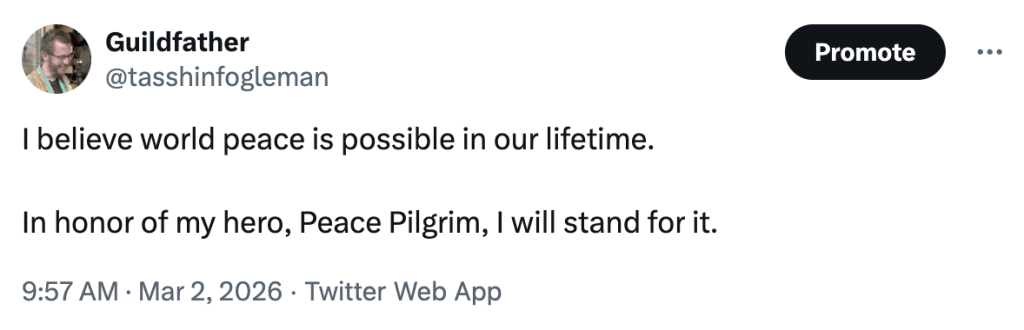
But increasingly, I believe world peace is genuinely possible. That it is a real possibility—and that it is possible in our lifetimes, no less.
I will stand for it. I will stand for world peace in our lifetimes.