
I first met Malcolm Ocean in 2018. In the next couple of years, we intersected and met at various places: at OAK in the Bay Area; in Atlanta, Georgia; at the Monastic Academy in Vermont for a Bio-Emotive Retreat…
At the time, in that chapter of our lives, I was training at MAPLE, and Malcolm was living at and embedded in Upstart Collaboratory in Waterloo.
Over that time, Malcolm and I got to know each other better and better. We had an initial warmth and mutual respect that developed into friendship and a sense of collaboration, alliance. We both had a sense that we could learn from each other as individuals, and that our respective communities could learn and grow from each other as peers, with similar aims and goals, albeit distinct backgrounds and methodologies.
And, I think it’s fair to say that there was something of a mutual wariness! We were very similar in some ways, and very different in other ways. I have thought of Malcolm as one of my “evil twins” for quite some time—not an evil person, but “somebody who thinks exactly like you in most ways, but differs in just a few critical ways that end up making all the difference.”
Frankly, I had to grow up a bit in order to fully appreciate Malcolm, to truly see him as a person and love him as a friend. I had to leave MAPLE, go off on my own, do some of my own work and projects, do some shadow work and emotional processing, change as a person, become more truly myself. The more parts of myself I witnessed, loved, respected, and expressed, the more love I felt for Malcolm, and the easier it was to be friends with him.
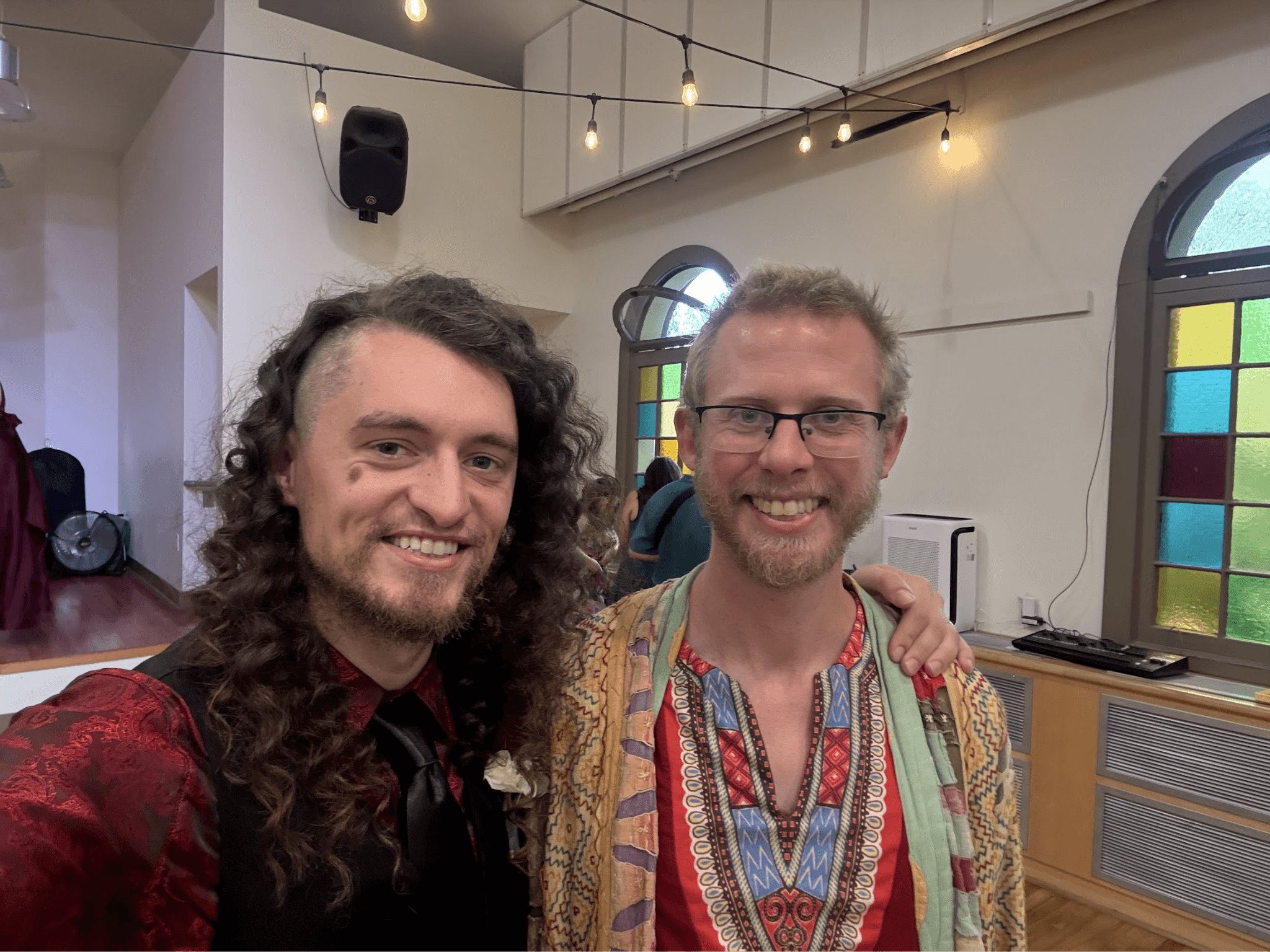
During that time, Malcolm discovered what he calls the Non-Naive Trust Dance (NNTD). I saw him become very, very excited about these ideas, and start to share them with the world. I was curious, intrigued by what I heard him saying, what I saw him writing, but I didn’t fully understand what he was on about.
I had him on my podcast in 2021 to interview him (video / audio / transcript), with the hope of beginning to understand NNTD. I could see that Malcolm was on to something, and to the extent that I understood NNTD, it was incredibly impactful. It had explanatory power that helped me to make sense of some situations I had been in previously that were confusing and hurtful, hard to understand and navigate in a way that felt good for me and kind to other people.
Malcolm has written and spoken extensively about the Non-Naive Trust Dance. There’s an abundance of material about NNTD, and his understanding of it! And he’s incredibly enthusiastic about sharing it with the world. But that said, I found the ideas themselves and his explanations of them difficult to understand, confusing, obscure, even impenetrable. And I think other people have, too.
I’ve noticed that the people who invent something are not always good at explaining it. The set of mental skills required to notice and solve a complex problem are meaningfully distinct from the set of skills required to communicate it to other people, especially the general populace.
Typically, the inventors or discoverers of an idea are most able to explain and transmit their ideas to their peers, who have a similar context and have likely already noticed similar problems themselves, who are well-suited and well-positioned to understand.
It takes a different kind of person to translate what the inventor and their peers have seen and come to understand, into language that can make sense to a broader audience and the world at large. Someone who speaks clearly and plainly, who is capable of distilling theoretical complexity and complectity into simple, practical explanations and applications.
I think that these observations apply to Malcolm, and NNTD! I see Malcolm as brilliant, a genius of his own kind and shape and form—and NNTD as an incredible discovery and gift to humanity1I sometimes think that my job is to become MDMA embodied. To me, Malcolm is like acid, embodied—but with Roam Research, and a self-editing LISP-like consciousness, and…
I see Malcolm as something like a genius before his time. It reminds me of how people can’t help but imagine what Mozart or Bach or Beethoven would do with a DAW, if they had a laptop and Ableton and a good studio and banging speakers. I wonder what Malcolm will, would do with the sci-fi-like affordances that are yet to come—with hive minds, or widespread collective intelligence, or self-editing brain-interface technologies, or AGI, or…. And, it’s still early days—we are still learning to understand, describe, articulate, and share its powerful insights about trust and distrust with the world.
Despite not fully understanding NNTD, I kept thinking about it. It continued to be a valuable frame on my past experiences, and to give me a new sense of possibility and range of motion in my present experiences and contexts. I felt hungry to understand more, both the ideas themselves, and how to apply them practically in situations I cared about.
I had questions like:
- What are trust and distrust, anyway?
- What is NNTD? What is naive trust? What is non-naive trust? What is “trust dancing”? What is the opposite of trust dancing?
- Why did situations A, B, and C in my past not feel good, not go well?
- What can I do to help situations X, Y, Z that I am presently in, and care deeply about, go well, now and in the future?
- What is a cult, anyway?
- How should I relate to my own trust and distrust? How should I relate to others’ trust and distrust?
- What do I actually do to apply these ideas?
- What are the implications of these ideas for the larger communities and cultures I am connected to, for humanity at large, for this Earth (and our galaxy) at this time?
Malcolm listed his own questions that are addressed by NNTD as follows:
- How do you build non-naive trust, between people or within yourself?
- How can experiences of distrust (or betrayals of trust) be turned into a generative resource, rather than a roadblock?
- How do you actually “trust yourself when all men doubt you, but make allowance for their doubting too”? (from Kipling’s poem “If—“) (video)
- How can people or groups that are operating in cultures based on the emerging new post-judgmental, collaborative, Game B platform mutually recognize that they are doing so?
- To the extent that a given person or group is confused about some aspect of collaborative culture, how can they realize & integrate such a confusion, in dialogue with other people?
- How can people learn to operate in collaborative (non-coercive) ways?
- How can a high-trust group of people honor ways in which people (inside or outside of the group) are not yet able to trust them?
In recent months, I’ve worked with Malcolm and our friend Michael Smith to deepen my understanding of NNTD. They’ve graciously had a number of conversations with me to help me understand NNTD, on my own terms, in words and metaphors that make sense to me, that work for my mind and heart. I’ve also done an extensive deep dive into Malcolm’s body of work, researching how his writing and thinking have evolved over time.
This period of study, research, and translation has helped me to understand NNTD far more fully. I want this work to serve me and the immediate contexts I care about, but I also want to share this understanding with my friends, allies, and the world at large.